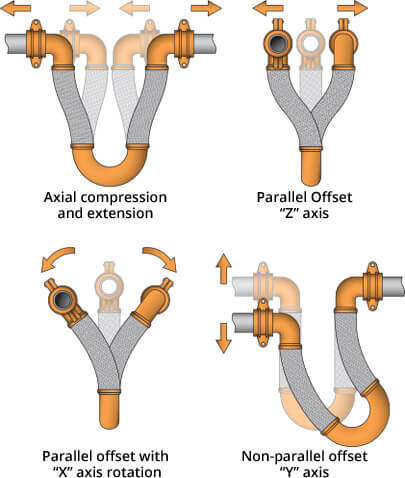
Until now the issue concerning the Seismic-Rated Flexible Expansion Joint Assembly is one of the most least understood technical matter and at times has resulted to confusions. This technical article will distinguish which flexible expansion joint assembly is indeed appropriate for seismic application. The NFPA-13 Standard called it as “Seismic Separation Assembly” while the ASCE 7-10 Standard called it as “Piping Flexibility.”
The NFPA-13 Standard has stipulated the requirements for Seismic Separation Joint Assemblies:
13 STANDARD (Section 9.3.3) STANDARD FOR THE INSTALLATION OF SPRINKLER SYSTEMS.
“Seismic Separation Assemblies shall consist of flexible fittings or
flexible piping so as to allow movement sufficient to accommodate
closing of the separation, opening of the separation to twice its normal
size, and movement relative to the separation in the other two
dimensions in an amount equal to the separation distance.”
The ASCE 7-10 Standard the reference document of the IBC, also stipulated the requirements for Piping Flexibility for seismic application:
7-10 STANDARD MINIMUM DESIGN LOADS FOR BUILDINGS AND OTHER STRUCTURES.
ASCE 7-10 Chapter 11 – 11.1.2 “Every structure, and portion thereof, including nonstructural components, shall be designed and constructed
to resist the effects of earthquake motions as prescribed by the seismic requirements of this standard.”
ASCE 7-10 Chapter 13 – 13.6.6 “At the interface of adjacent structures or portion of the same structure that may move independently, utility lines shall be provided with adequate flexibility to accommodate the anticipated differential movement between the portions that move independently.”
ASCE 7-10 Chapter 15 – 15.7.4 “Piping systems connected to tanks and vessels shall consider the potential movement of the connection points during earthquakes and provide sufficient flexibility to avoid release of the product by failure of the piping systems. The piping system and supports shall be designed so as not to impart significant mechanical loading on the attachment to the tank or vessel shell. Local loads at piping connections shall be considered in the design of the tank or vessel shell. Mechanical devices which add flexibility such as bellows expansion joint and other flexible apparatus may be used when they are designed for seismic loads and displacements.”
ASCE 7-10 Chapter 17 – 17.2.6.3 “Elements of seismically isolated structures and nonstructural components, or portions thereof that cross the isolation interface shall be designed to withstand the total maximum displacement.”
NOTES: ASCE 7-10 Chapter 15 – 15.7.4, for more details, please request for my technical article, title “Ground-Supported Water Storage
Tanks / Reservoirs.” ASCE 7-10 Chapter 17 – 17.2.6.3, for more details, please request for my technical article (booklet), title “Seismically Isolated Structures.”
All critical piping systems should be protected against “Differential Movement” and “Unpredictable Movement” when two or several
adjacent buildings, facility structures, non-building structures, and equipment start to move differently (non-simultaneous) from each other
during Major Earthquake event. The points of vulnerabilities are as follows:
Above-ground pipelines regardless of their sizes that are crossing the building’s structural separation joint or structural gap (seismic gap).
Above-ground pipelines regardless of their sizes that are linked between two or several buildings or facility structures,
as well as the elevated pipe rack bridges adjoining two separate buildings or facility structures having their own independent
structural foundations.
- Above-ground pipelines regardless of their sizes that are crossing the seismic moat perimeter of the isolated buildings or facility structures.
- Above-ground pipelines regardless of their sizes that are directly connected to the huge ground supported storage tanks / reservoirs.
RULE OF THUMB: In order for any particular type of flexible expansion joint assembly to be 100% Qualified for seismic
application, it shall be fully capable to flex in the ± X-Axis, ± Y-Axis, and ± Z-Axis, plus the potential Rotational Movement, as shown in Figures – 1 & 2.
Because the low-frequency sinusoidal seismic waves with varying strength may come from any direction, such as: North-to-South, South-to-North, East-to-West, West-to-East, North-East, North-West, South- East, or South-West.